
Hydroxy ethyl cellulose (HEC), a non-ionic, water-soluble polymer, is a white, free-flowing granular powder. Nature-derived from sustainably sourced cellulose, MATECEL® HEC products are water-soluble, non-ionic polymers that can be used in a variety of personal and home care applications. It is easily dissolved in cold or hot water to give crystal-clear solutions of varying viscosities. These efficient thickeners perform across a wide pH range and demonstrate high salt tolerance and broad surfactant compatibility, enabling clear formulations.
Hydroxyethyl cellulose (HEC) powder is a water-soluble polymer derived from cellulose. It is widely used in various industries due to its thickening, gelling, and stabilizing properties.
Hydroxyethyl cellulose is one of the most versatile cellulose ethers in commercial production. The following industry applications reflect the primary demand segments for HEC powder:
Paints and Coatings (Latex Paint / Emulsion Paint)
HEC is the standard thickener for water-based architectural and industrial coatings. In latex paints and emulsion paints, it controls in-can viscosity, improves leveling and sag resistance, prevents pigment settling, and enhances film build. HEC is compatible with most latex systems and does not affect color development or gloss. Typical usage: 0.2–0.5% by weight of total formulation.
Construction Materials
In cement-based dry mix mortars, tile adhesives, wall putty, renders, and self-leveling compounds, hydroxyethyl cellulose serves as the primary water retention and workability agent. It keeps water available for cement hydration, extends open time, improves adhesion to substrates, and prevents cracking from rapid moisture loss. HEC is often used in combination with HPMC or MHEC depending on the performance target.
Oil and Gas Drilling
HEC has long been used in drilling fluid systems (water-based muds) as a viscosity modifier and fluid loss control agent. In oilfield applications, HEC keeps drill cuttings suspended, lubricates the drill string, maintains borehole stability, and reduces fluid loss into porous formations. Its salt tolerance makes it effective in saline drilling conditions. Typical grades for oil drilling have viscosities in the range of DR100,000 or custom-specified.
Personal Care and Cosmetics
In skin care, hair care, and body wash formulations, hydroxyethylcellulose functions as a thickener, film-forming agent, and rheology modifier. It thickens shampoos, shower gels, lotions, and cleansers without altering skin feel, while its non-ionic nature makes it compatible with cationic, anionic, and amphoteric actives. HEC also provides a smooth, non-sticky texture in gel formulations and helps stabilize emulsions.
Pharmaceuticals
In pharmaceutical applications, HEC serves as a binder in tablet production, a viscosity modifier in topical gels and ophthalmic solutions, and a controlled-release matrix material in oral dosage forms. Its non-toxicity and regulatory acceptance in major pharmacopoeias (USP, EP) make it a reliable excipient.
Adhesives and Sealants
HEC enhances the open time, tack, and flow properties of water-based adhesives. It improves the workability of wallpaper adhesives, wood glues, and construction sealants, while also providing water retention during application.
Textile and Paper Industries
In textile sizing and printing, HEC acts as a thickener for printing pastes, improving dye fixation and print clarity. In paper manufacturing, it is used as a surface sizing agent and coating binder, improving surface smoothness and printability.
Detergents and Household Products
HEC stabilizes the viscosity of liquid detergents, dishwashing gels, and fabric softeners, improving shelf appearance and ensuring consistent dispensing. Its salt tolerance is particularly useful in formulations with high electrolyte content.
MATECEL® HEC Features:

Good enzyme resistance

Smooth leveling and flow

Advanced thickening ability

Improve suspension rate
MATECEL® HEC Application:

Paints

Cosmetics and detergents

Construction

Pharmaceuticals

Food Industry

Oil and Gas
Package Information
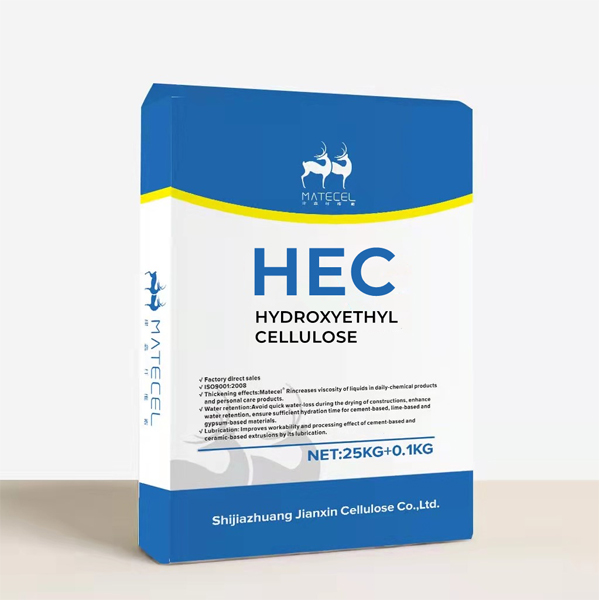
| Item | Specification |
| Size | 850mm*600mm*100mm |
| Weight | 25 KG/Bag |
| Corlor | Blue, White, Yellow |
| Storage | Dry and clean conditions |
Solubility: HEC powder dissolves readily in cold or hot water, forming clear, viscous solutions.
Thickening: Hydroxyethyl Cellulose powder is Effective at low concentrations, providing high viscosity.
Stability: Hydroxy ethyl cellulose is stable over a wide pH range and compatible with many other ingredients.
Film Forming: HEC powder can form flexible, clear films, making it useful in coatings and adhesives.
Today, we have become one of the most important producers of cellulose ethers and other construction additives in China. If you have any questions about hydroxyethyl cellulose powder, please contact us.
HEC delivers a combination of functional properties that few water-soluble polymers can match simultaneously:
Water retention: HEC holds water in cementitious and coating systems, preventing premature drying, improving open time, and supporting complete hydration of cement particles. This is critical in tile adhesives, renders, and self-leveling compounds.
Viscosity control and thickening: As a rheology modifier, hydroxyethyl cellulose provides pseudoplastic behavior — high viscosity at rest for good sag resistance, and lower viscosity under shear for easy application. The viscosity grade you select determines the flow profile of your finished product.
pH and electrolyte stability: HEC maintains its thickening efficiency across the full alkaline range typical of construction systems, as well as in high-salt environments found in oilfield drilling muds. This broad stability is a key differentiator from ionic cellulose ethers.
Film formation: HEC solutions form clear, flexible, and water-resistant films on drying — valuable in coatings, printing inks, and paper treatments.
Suspension and stabilization: In paints and emulsions, HEC keeps pigments and fillers evenly dispersed and prevents settling during storage.
Protective colloid: HEC acts as a steric stabilizer in emulsion polymerization, preventing agglomeration and maintaining particle size distribution.
Biocompatibility and non-toxicity: Derived from natural cellulose, HEC is non-toxic, biodegradable, and compatible with skin and mucous membranes — enabling its use in personal care and pharmaceutical applications.
Hydroxyethyl cellulose (HEC) is generally considered safe for consumption in food products, but it's important to distinguish between food-grade and industrial-grade HEC.
Approval and Regulations: Food-grade HEC is approved by various health and safety regulatory authorities, such as the FDA (Food and Drug Administration) in the United States, for use in food products. It is often listed as a food additive and can be found under specific regulations concerning its use and safety limits.
Uses in Food: In the food industry, HEC is used as a thickener, stabilizer, and emulsifier. It can be found in products like sauces, dressings, beverages, and processed foods to improve texture and stability.
Safety: Food-grade HEC is considered safe for consumption when used within the recommended limits. It is non-toxic, non-allergenic, and does not contribute to the caloric value of the food. It is also indigestible, passing through the digestive system without being absorbed, similar to dietary fiber.
Not for Consumption: Industrial-grade HEC, used in applications like paints, coatings, and construction materials, is not intended for consumption. It may contain impurities or additives not suitable for ingestion.
Potential Risks: Consuming industrial-grade HEC could pose health risks due to these impurities. Therefore, it should never be used in food or pharmaceutical products.
General Precautions:
Source Verification: Always ensure that the HEC used in food products is specifically labeled and approved for food use.
Regulatory Compliance: Follow guidelines and regulations set by health authorities regarding the use and acceptable daily intake of food-grade HEC.
How is hydroxyethylcellulose (HEC) used in water-based paint?
HEC is the abbreviation of hydroxyethyl cellulose. It is a water-soluble natural or semi-synthetic polymer that is the product of chemical modification of cellulose. Cellulose is one of the main components of plant cell walls, and hydroxyethyl cellulose is modified by introducing hydroxyethyl groups into the cellulose molecules.
Why Is HPMC a More Cost-Effective Alternative to HEC?
Hydroxyethyl cellulose (HPMC) and hydroxyethyl cellulose (HEC) both belong to cellulose ethers and are widely used in the industry due to their unique properties. These cellulose ethers are used in a variety of applications, ranging from construction materials to pharmaceuticals and personal care products.
What is the difference between HPMC and HEC?
Hydroxyethyl cellulose (HPMC) and hydroxyethyl cellulose (HEC) are two common cellulose ethers. Although HPMC and HEC are both cellulose ethers, their synthesis processes, performance characteristics, application fields, and film-forming characteristics There are certain differences in aspects such as cost-effectiveness and cost-effectiveness.
Unraveling the Distinctions Between CMC and HEC
In the vast landscape of industrial chemicals, two cellulose derivatives stand out for their versatility and wide-ranging applications: Carboxymethyl Cellulose (CMC) and Hydroxyethyl Cellulose (HEC). Understanding the differences between these compounds is essential for industries ranging from food and pharmaceuticals to paints and personal care.
LEAVE A MESSAGE

Shijiazhuang Henggu Matecel Cellulose Co., Ltd.
Chemical Industrial Park, Xinji City, Hebei Province, China Post Code: 052360
Copyright 2023 Shijiazhuang Henggu Matecel Cellulose Co., Ltd. All Rights Reserved

 русский
  EN
EN  Türk
Türk  Português
  Français
  Español
  中文
中文